Fencing and Body Asymmetry: What to Train Off the Piste
Quick Answer: Fencing loads one side of your body far harder than the other - the front leg absorbs the lunge, the weapon arm works constantly, and the torso holds a rotated position for hours. The fix is not to fence less; it is two 20-minute sessions a week of deliberately asymmetric strength work, weighted toward the side that does less. Prioritise rear-leg single-leg strength, non-dominant side rotation, and thoracic rotation both ways. Most fencers find the back and hip niggles settle within six to eight weeks.
Every unilateral sport builds asymmetry, and fencing builds an unusual amount of it because the stance itself is asymmetric before you have moved at all. The good news is that this is one of the more predictable problems in sport, which means it is one of the more fixable.

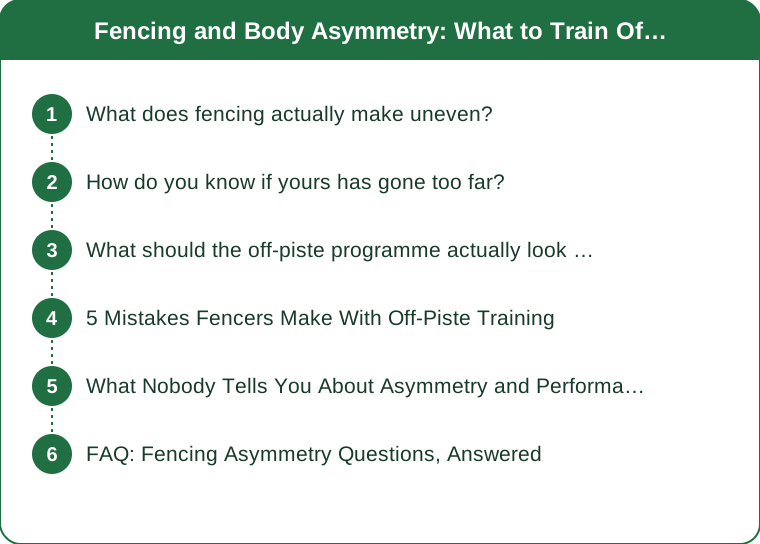
What does fencing actually make uneven?
Four specific things, and they are more precise than a general sense of being lopsided.
The front leg does the braking. Every lunge is decelerated by the front quad and hip eccentrically, at speed, hundreds of times a session. The rear leg drives, which is a different and generally lower-volume demand. Over a season the front quad and the rear glute develop very differently.
The torso holds rotation. En garde places you rotated toward your weapon side and you stay there. Sustained rotation shortens tissue on one side of the trunk and lengthens it on the other, and hip rotation range follows.
The weapon arm works constantly at low load. Forearm and wrist on one side accumulate an enormous number of small repetitions. This is why fencing forearm and elbow complaints are common and why they are almost never a one-off injury.
The shoulders sit differently. Weapon shoulder forward and slightly elevated, off-hand shoulder back. Held for two hours, twice a week, for years.
None of these is a problem on its own. The problem is that all four compound in the same direction, and nothing in normal fencing training pushes back.
How do you know if yours has gone too far?
Four checks you can do in ten minutes, and it is worth writing the numbers down.
Single-leg sit-to-stand. From a standard chair, one leg, no hands. Count reps to fatigue on each side. A difference of more than 20% is worth acting on, and most established fencers find the rear leg is the weaker one despite it feeling like the working leg.
Seated thoracic rotation. Sit on a chair, arms crossed on your chest, rotate as far as you can each way. A clear difference between sides is very common and very trainable.
Hip internal rotation. Lie face down, knees bent to 90, let the lower legs fall outward. Compare. Fencers frequently lose internal rotation on the front leg specifically.
Single-leg balance with eyes closed. 20 seconds is a reasonable target. Big side-to-side differences here are the most predictive of the four for ankle and knee problems.
Repeat these every eight weeks. The trend matters more than the absolute number - a fencer whose gap is closing is doing the right things regardless of where they started.
What should the off-piste programme actually look like?
Two 20-minute sessions a week is enough, and the structure matters more than the volume.
Start every exercise with the weaker side, and let it set the number. If the rear leg manages 8, the front leg does 8, not 12. This is the single most important rule and the one people ignore because it feels like leaving work on the table.
The core four:
Rear-foot elevated split squat. The best single exercise for fencing asymmetry. It loads one leg through a deep hip range, and it directly addresses the rear-leg deficit. 3 sets of 8 each side.
Single-leg Romanian deadlift. Trains the posterior chain and balance in one move. 3 sets of 8 each side, slow.
Half-kneeling anti-rotation press (Pallof). Resist rotation rather than produce it. Do more sets facing the direction that fights your fencing rotation. 3 sets of 10 each side, 4 on the weak direction.
Side plank. Simple, and reliably uneven in fencers. 3 sets of 30 seconds each side.
Add thoracic rotation drills both ways as a warm-up, and wrist and forearm work for the weapon arm - it is the most common overuse site and the easiest to prevent.

5 Mistakes Fencers Make With Off-Piste Training
1. Training both sides equally. Equal training preserves an existing gap. To close one you have to train unequally, deliberately, for a period.
2. Doing only bilateral lifts. Back squats and conventional deadlifts let the strong side take over, and the stronger side gets stronger. Single-leg and single-arm work is where the asymmetry actually gets addressed.
3. Stretching the tight side and stopping there. The short side is usually short because the opposite side is weak. Stretch if you like, but the durable change comes from strengthening the long, weak side.
4. Loading the front quad more. It is already the most-trained tissue in your body. Heavy front-leg quad work on top of a fencing week is how patellar tendon problems start. Train the rear leg and the glutes.
5. Starting it in season and dropping it when competitions begin. The eight weeks after a season ends are the best window, and the weeks before a competition are when people quit. Two 20-minute sessions survive a competition schedule; a 60-minute one does not.
What Nobody Tells You About Asymmetry and Performance
The uncomfortable part: some asymmetry is adaptive and you should not try to erase it.
A fencer with ten years on the piste has a front leg that is better at eccentric deceleration and a weapon arm with far better fine motor control. That is skill-specific adaptation and it is why you are good. Chasing perfect left-right symmetry would take training time away from the thing that makes you effective.
The distinction that matters is between adaptation and deficit. Adaptation is the strong side being unusually good. Deficit is the other side being below a functional baseline - and that is what causes problems.
So the goal is not symmetry. It is a floor. The rear leg should be strong enough to do its job, the non-weapon shoulder should be stable, the trunk should rotate adequately in both directions. Get the weak side above the floor and stop, rather than trying to match the strong side.
One practical consequence: the assessments above are pass or fail, not a score to maximise. A 20% gap that has been stable for years in a fencer with no symptoms is not an emergency. A 40% gap in someone with a recurring back niggle is.
FAQ: Fencing Asymmetry Questions, Answered
When in the year should I do this?
Heaviest in the off-season, maintained in season. Eight focused weeks after a season ends produces the largest change, and two short sessions a week holds it.
Will training my non-dominant side make me a worse fencer?
No. General strength work on the non-dominant side does not interfere with weapon-side skill, and the improved trunk control usually helps footwork.
Should I fence left-handed sometimes to even it out?
It is not worth the training time. The asymmetry that causes problems is in strength and range, and those are addressed far more efficiently in the gym than by fencing badly on the wrong side.
This is general information, not medical advice. Persistent back, hip, or elbow pain is worth getting assessed rather than trained around.
TL;DR:
- Fencing loads the front leg, weapon arm, and one direction of trunk rotation - and nothing in normal training pushes back.
- Test single-leg sit-to-stand, thoracic rotation, hip internal rotation, and eyes-closed balance every eight weeks.
- Two 20-minute sessions a week: split squats, single-leg RDLs, Pallof press, side plank - weak side first, and it sets the reps.
- The goal is a functional floor on the weak side, not perfect symmetry. Some asymmetry is why you are good.
The fencers who last are rarely the ones who fenced the most. They are usually the ones who spent forty minutes a week on the side of the body that the sport ignores.
Keep Reading
This article is for general informational and styling purposes only. Fit, sizing, and product availability may vary.