The Fencing Club Etiquette Nobody Explains on Your First Night
Quick Answer: Fencing has more unwritten etiquette than most sports because it inherited it from duelling, and clubs rarely explain it because regulars stopped noticing it. The three that matter most on night one: always salute and shake hands, never remove your mask until both fencers have stopped, and acknowledge a hit you felt. Get those right and everything else is forgiven.
Nobody hands you the etiquette list. You learn it by doing something slightly wrong and noticing a pause.
None of it is difficult and none of it is precious — most of it is either safety or the ordinary courtesy of a sport where you point sharp things at people. Here it is in advance.
What do I do at the start and end of a bout?
Salute, mask on, fence, mask off, salute, shake hands. In that order, every time, including in casual club bouts.
The salute is a brief raise of the blade towards your opponent — bring the guard up near the chin and then extend the arm down and forward. It is quick. It is not a performance. You salute your opponent, and in a refereed bout the referee and any spectators too. Skipping it in a competition can technically result in a penalty; skipping it at a club just reads as not knowing.
The handshake at the end is mandatory in spirit and near-mandatory in the rules. Ungloved hand, or with the glove off if you can manage it gracefully. Refusing a handshake is one of the very few things that will get you spoken to seriously.
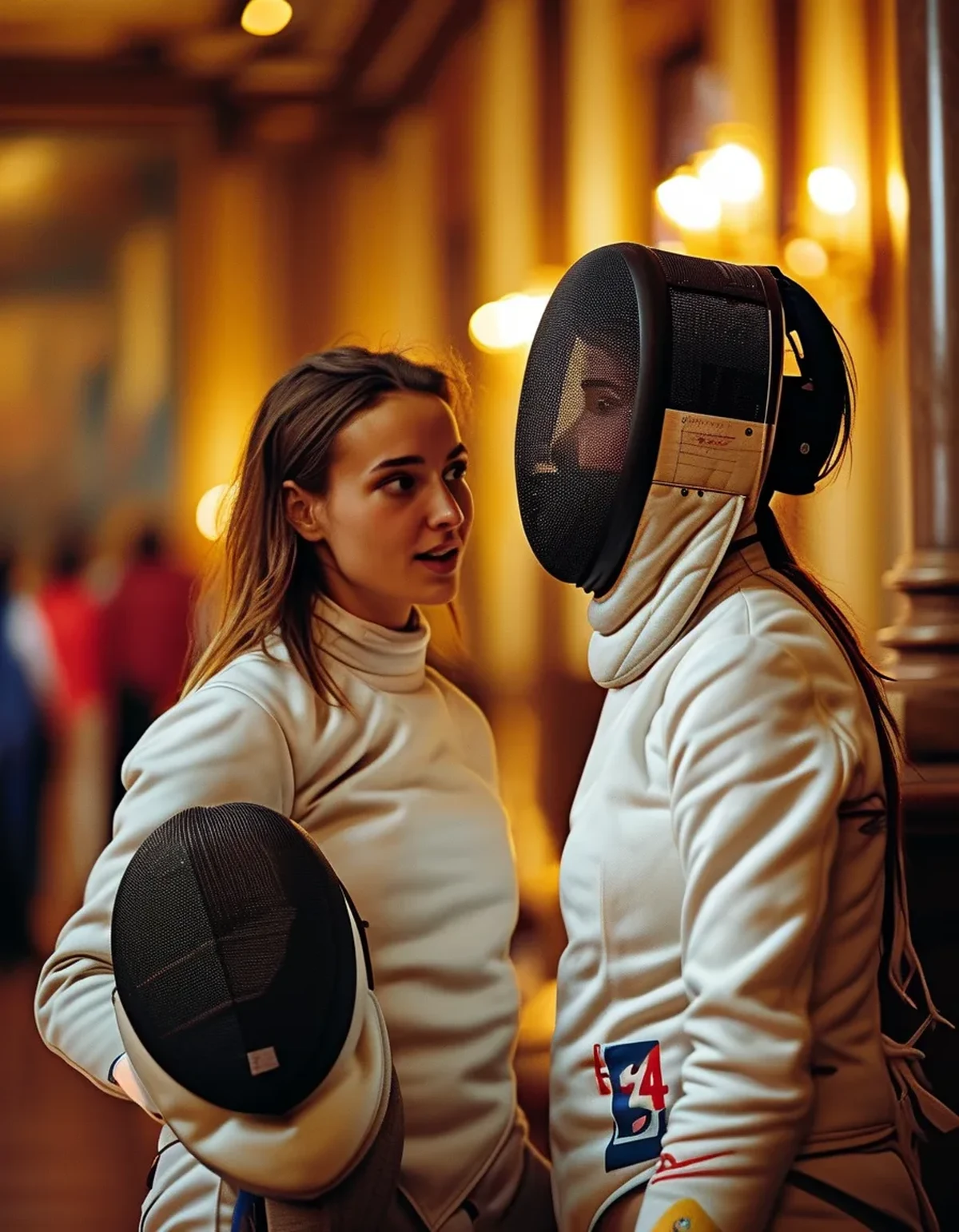
Masks stay on until both fencers have stopped. This is the one where etiquette and safety are the same rule. Do not lift your mask to talk, to check the score, or because you think the point is over. Wait until your opponent has lowered their blade and stopped moving. Blades continue moving after a phrase ends more often than beginners expect.
Point your blade at the floor when not fencing. Walking around a club with a blade held up is the fastest way to make everyone tense.
Salute your coach after a lesson. Same gesture, and it matters to most coaches more than they say.
How do I ask someone for a bout without getting it wrong?
Directly, briefly, and with an easy exit for them.
The phrasing that works: Are you free for a bout? or Would you mind fencing a few hits? Both give a clean no. Anyone mid-lesson, mid-warm-up or in a conversation is a no by default; do not interrupt a lesson to ask.
Ask people at your level and slightly above. More experienced fencers will generally say yes to a beginner, and there is a real limit on how many of those they can do in an evening. Do not ask the same senior fencer three times a night.
When someone much better agrees, expect a different kind of bout. They will usually fence to give you something to work on rather than to win 15-0. That is a gift, and the correct response is to try things rather than defend desperately. Say thanks afterwards and mention what you were working on — most experienced fencers will then tell you something useful.
Piste etiquette: if a strip is occupied, wait at the end rather than at the side, and do not walk across an active strip. If you need to cross, wait for the phrase to end or go around. Walking through a bout is the single most common beginner error and the one most likely to earn a sharp word.
Sharing a strip in a busy club is normal — two pairs at either end of a long piste. Agree on it out loud before starting, and keep an eye on the distance.
How many hits? Casual club bouts are usually to 5. Say so at the start: To five? Ending is then unambiguous, which avoids the awkward drift where nobody knows if it is over.

What Nobody Tells You About Acknowledging Hits
This is the etiquette that separates people who are pleasant to fence from people who are not, and it is entirely invisible until you get it wrong.
In unrefereed club bouts, you acknowledge hits you felt. A raised hand, a nod, or simply saying yours. This is the whole basis of casual fencing without a referee, and it depends on both people being honest.
Acknowledging generously is the norm, not the exception. If you are unsure whether a hit landed, give it. Fencers who consistently give doubtful hits to their opponent are the ones everyone wants to fence, and it costs nothing at a club night.
Do not argue right of way with your opponent. In foil and sabre, right of way decides who scores when both fencers hit, and it is genuinely complicated. In an unrefereed bout, if you disagree, the correct answer is to replay the point rather than debate it. In a refereed bout, the referee decides and that is the end of it — you may politely ask for a clarification once, and you do not get to make a case.
The electric scoring caveat: the box registers a hit; it does not register whether it was valid. Off-target lights in foil and priority in sabre are still judgement. A light is not an argument.
Do not celebrate hard. A quick reaction is normal and human. A sustained celebration in a five-hit club bout reads badly, and in competition it can draw a card. Fencing has an unusually strong culture around this, inherited directly from its duelling origins.
And the corollary: do not apologise for every hit you score either. One sorry after a genuinely hard hit is courteous; apologising for scoring is tiring for your opponent.
Kit, borrowing, and the practical stuff
The physical logistics that nobody mentions and everybody notices.
Club kit is shared, sweaty and finite. If you borrow, hang it back properly rather than leaving it in a pile, and tell someone if something is damaged — a failed mask or a cracked blade left in the rack is a genuine safety issue for whoever picks it up next.
Buy your own glove first, then a mask. The glove is cheap, personal and the item you least want to share. The mask is the next priority for hygiene and fit. Weapons and full kit can wait — most clubs are happy to lend those for months.
Wash your kit. Fencing jackets get badly sweaty and the culture around this is more relaxed than it should be. Airing it after every session and washing regularly is not fussy, it is basic courtesy in a sport played at close quarters.
Check your own kit before fencing. Mask bib secure, jacket fully done up, plastron on underneath, no gaps at the wrist or waist. This is your responsibility and not the club’s, and the moment it matters is the moment it is too late.
Bring water and expect to need more than you think. Fencing in a full jacket and mask is hotter than it looks, particularly in a hall at the end of summer before the weather cools properly.
Help pack down. Clubs run on a small number of people rolling up pistes and putting equipment away. Being one of the people who stays for ten minutes at the end is the fastest route to being genuinely part of a club, and it is noticed far more than anything you do on the strip.
On returning after a break: if you have been away over the summer, say so before your first bout. People will adjust, and it saves you the experience of being fenced at full pace with three months of rust.
FAQ: Fencing Club Etiquette Questions, Answered
What if I genuinely do not know whether a hit landed?
Give it, or offer to replay. Both are completely normal and neither will be held against you. Doubt in your opponent’s favour is the standing convention.
Is it rude to decline a bout?
Not at all. Not right now, thanks is completely fine and everyone declines regularly — fatigue, injury, waiting for a lesson. Nobody needs a reason.
How do I know if I am fencing too hard?
If your opponent flinches, backs up repeatedly, or stops talking, ease off. Hitting hard is not a skill and is frowned on across all three weapons. The blade only needs to bend, not to hurt.
What do I call the coach?
Whatever the club calls them, which you will hear within five minutes. Some clubs are formal, most are first names. When in doubt, ask someone rather than guessing.
Do I salute in casual practice too?
Yes. It is fast, it marks the start and end of a bout clearly, and doing it automatically means you will not forget it when it counts.
I got something wrong and someone corrected me. How bad is it?
Almost certainly not bad at all. Fencing clubs correct beginners constantly and think nothing of it — the correction is the club including you, not excluding you. The only genuinely serious ones are mask removal, walking across a strip, and unsafe kit.
TL;DR:
- Salute, mask on, fence, mask off, salute, shake hands. Every bout, including casual ones.
- Mask stays on until both fencers have completely stopped. This one is safety, not manners.
- Acknowledge hits generously and never argue right of way — replay it or accept the referee.
- Never walk across an active piste; wait at the end.
- Buy your own glove first, wash your kit, and stay for the pack-down.
None of this is gatekeeping. It is a sport with sharp objects and a long memory, and the etiquette is mostly just the practical version of paying attention.
Keep Reading
This article is for general informational and styling purposes only. Fit, sizing, and product availability may vary.