The Fencing Lunge Mistake That's Quietly Wrecking Beginners' Knees
Quick Answer: Fencing knee pain almost always comes from the front knee traveling past the toes or caving inward during the lunge. Keep the knee stacked directly over the ankle and the shin roughly vertical at full extension, and most beginner knee complaints disappear within a few weeks.
You signed up for fencing for the swordplay, not for a physical therapy referral. But if your front knee aches after every class, the lunge — the single most repeated movement in the sport — is almost certainly the cause.
Why does the fencing lunge stress the knee?
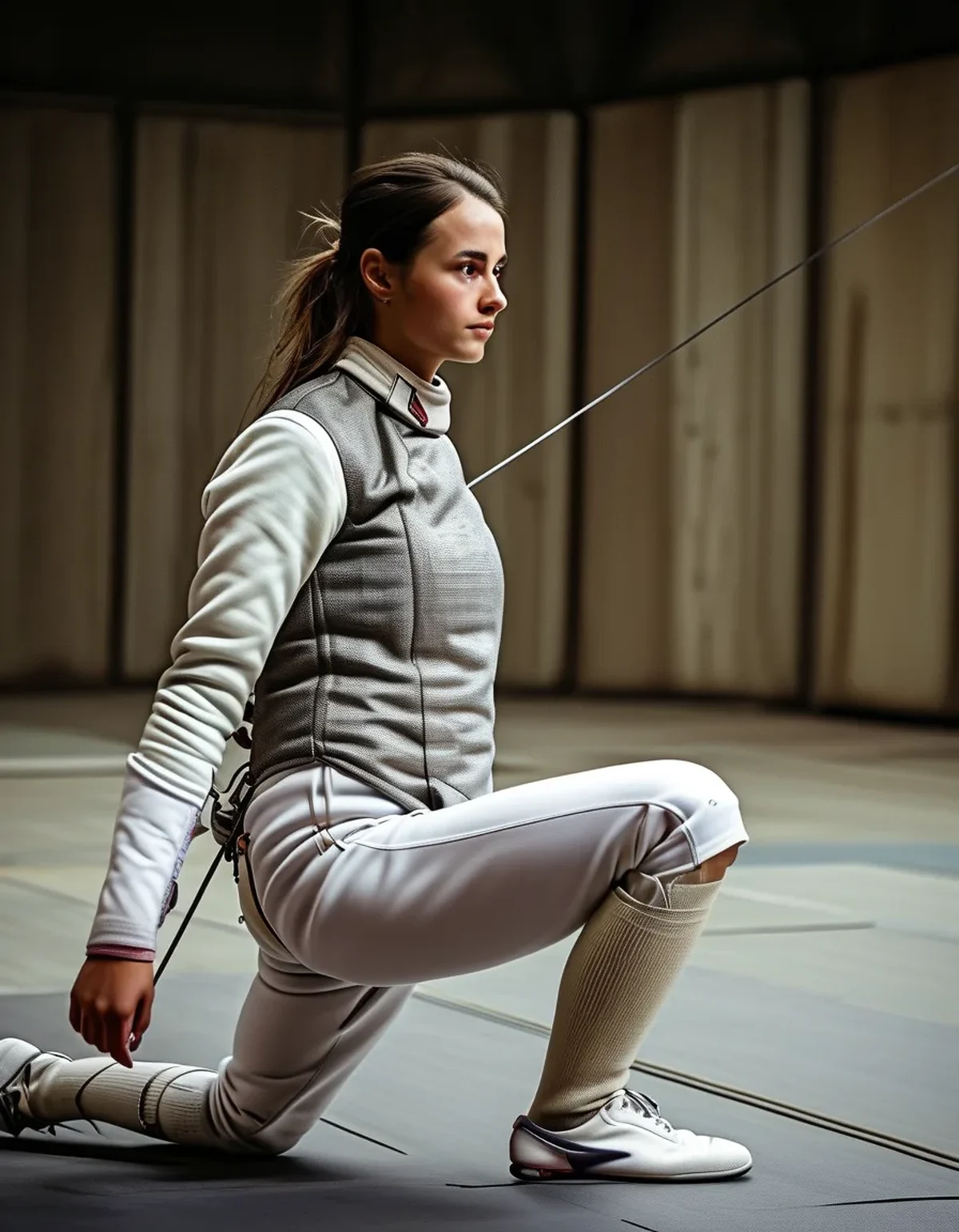
A competitive lunge covers significant distance in a fraction of a second, and all that force lands through one bent front leg. If the knee drifts past the toes or rotates inward, the stress shifts from muscle to ligament — exactly the tissue that doesn’t like sudden load.
Beginners are especially prone to this because they’re focused on the blade and the opponent, not on where their knee is pointing. It’s an attention problem before it’s a strength problem.
How do you check your lunge form?
Have a partner film you from the side and from the front. From the side, at full lunge your front shin should be close to vertical — knee over ankle, not drifting toward your toes.
From the front, your kneecap should track over your second and third toes, not caving inward toward your big toe. That inward cave is the number one cause of fencer’s knee pain — it loads the inside of the joint asymmetrically.
What Nobody Tells New Fencers About Lunging
Coaches drill distance and speed early because that’s what wins touches — but knee tracking gets mentioned once and rarely revisited. By the time pain shows up, the faulty pattern is already grooved into muscle memory.
The fix isn’t complicated: it’s slow-motion lunge reps in front of a mirror, 10 per side, focused purely on knee path with zero speed or opponent. Most fencers skip this because it feels too basic to bother with — it’s exactly the drill that prevents the injury.
Also underrated: footwear. Court or fencing-specific shoes with lateral support change how the knee tracks compared to running shoes, which are built for forward motion only.
What strength work actually helps?
Single-leg glute bridges and lateral band walks, 2-3 times a week, build the hip strength that keeps the knee from caving during a fast lunge. Add Bulgarian split squats at low weight, focusing on knee tracking over speed, once basic strength is in place.
This isn’t about bulking the quads — it’s about hip stability, since a weak hip is what lets the knee collapse inward under load.
FAQ: Fencing Knee Safety Questions, Answered
Is knee pain from fencing normal for beginners?
Mild soreness from new movement patterns is normal for the first few weeks. Sharp or persistent pain during or after lunges is not — that’s a form or strength issue worth addressing early.
Should I tape or brace my knee for fencing?
A brace can help short-term while you correct form, but it’s a bandage, not a fix — relying on it long-term without addressing knee tracking just delays the same injury.
How long until better lunge form actually feels natural?
Most fencers report the corrected pattern feeling automatic after about 3-4 weeks of deliberate slow-rep practice, roughly 2 sessions a week.
TL;DR:
- Knee pain in fencing usually comes from the front knee caving inward or drifting past the toes during a lunge
- Film your lunge from the side and front to check knee tracking
- Hip strength (glute bridges, band walks) prevents the inward cave more reliably than knee-focused exercises
- Slow, mirror-checked lunge reps early prevent the injury that shows up months later
Spend one session a week on boring, slow lunges — it’s the least exciting fencing drill and the one that keeps you on the strip.
Keep Reading
This article is for general informational and styling purposes only. Fit, sizing, and product availability may vary.