Why Fencing Bouts Are Won More by Mental Game Than Pure Technique
Quick Answer: Fencing outcomes are heavily influenced by tempo control, reading an opponent’s patterns, and managing your own composure under pressure — factors collectively called the ‘mental game’ — which is why two fencers with comparable technical skill can have very different win rates against the same set of opponents.
Beginners tend to assume better technique wins bouts. Coaches consistently point to something else as the bigger differentiator once basic technical competence is established.

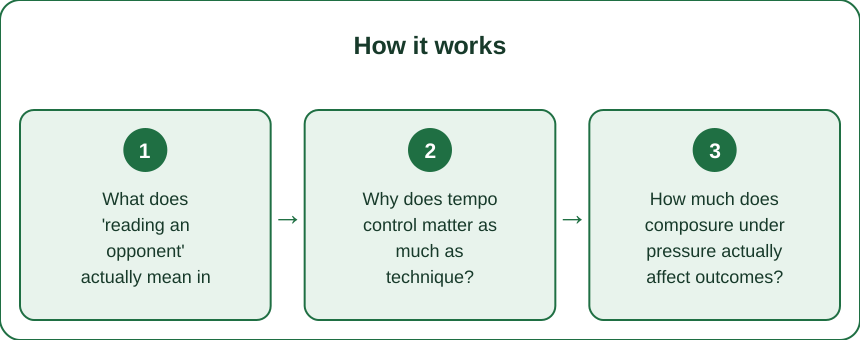
What does ‘reading an opponent’ actually mean in practical terms?
It means noticing patterns in an opponent’s timing, preferred distance, and go-to actions within the first few exchanges of a bout, then adjusting your own approach to counter those specific patterns rather than executing a fixed plan regardless of what the opponent is doing. Fencers who adapt mid-bout based on what they observe consistently outperform those running the same script every match.
Why does tempo control matter as much as technique?
Controlling the rhythm of exchanges — when to attack, when to draw out a pause, when to speed up — forces opponents to react on your timing rather than their own, which disrupts even technically sound opponents. A fencer with slightly weaker technique but strong tempo control often beats a technically superior opponent who can’t adjust to an unfamiliar rhythm.
How much does composure under pressure actually affect outcomes?
Significantly — fencers who maintain composure after losing a point or falling behind tend to fence their normal game, while those who get rattled often abandon sound strategy in favor of rushed, lower-percentage actions. This single factor is frequently cited by coaches as the biggest differentiator between fencers of similar technical level.

Myth vs Fact: The Mental Game in Fencing
Myth: Better footwork and blade technique are the primary determinants of bout outcomes. Fact: Once basic technical competence is established, tempo control and opponent-reading typically explain more variance in bout outcomes than further technical refinement.
Myth: Mental game is something you either have or don’t. Fact: Composure and pattern-reading are trainable skills, developed through deliberate bout experience and reflection, not fixed traits.
Can beginners actually start training the mental side, or is it too early?
Beginners can start immediately with a simple habit: briefly reviewing after each bout what patterns the opponent showed and when composure slipped, rather than only reviewing technical execution. This reflective habit, done consistently, builds the pattern-recognition and self-awareness skills that experienced competitive fencers rely on.
FAQ: Fencing’s Mental Game, Answered
Does experience automatically build mental game skill?
Experience helps, but only when paired with active reflection — simply fencing more bouts without reviewing patterns and composure builds technical reps more than mental game skill.
Is the mental game equally important in all three fencing weapons?
Yes, though the specific patterns look different — épée’s timing-heavy nature and foil/sabre’s right-of-way rules each reward tempo control and reading in weapon-specific ways.
How can composure specifically be practiced outside of competition?
Simulating pressure in practice bouts — fencing while purposely behind on the score, for example — helps build composure in a lower-stakes setting before competition.
TL;DR:
- Reading an opponent’s patterns and adjusting mid-bout outperforms a fixed technical plan
- Tempo control forces opponents onto your rhythm rather than their own
- Composure after falling behind is one of the biggest differentiators between similar-skill fencers
- Mental game skills are trainable through deliberate reflection, not fixed traits
Once basic technique is solid, the bouts you win or lose usually come down to tempo, reading, and composure — not who has the cleaner blade work.
Keep Reading
This article is for general informational and styling purposes only. Fit, sizing, and product availability may vary.