Why Fencing Reaction Time Feels Impossible to Improve at First (And What Actually Trains It)
New fencers often assume reaction speed is simply a fixed trait — you either have fast reflexes or you don’t — after watching experienced fencers respond to attacks in what looks like an instant. That assumption is wrong in a genuinely useful way. Here is why fencing reaction time is actually trainable, and the drills that build it fastest.

Why Reaction Time Feels Like a Fixed Trait Early On
The misleading first impression: the the-visible-speed-in-experienced-fencers-is-mostly-pattern-recognition-not-raw-reflex (the experienced fencers’ apparently instant reactions actually reflecting rapid pattern recognition of familiar attack setups rather than pure raw nervous-system reflex speed, a distinction invisible to a beginner watching from outside, per the fencing-distance-and-timing-guide logic — the what-looks-like-pure-reflex-speed-is-mostly-trained-pattern-recognition-not-an-innate-trait), the the-a-beginner-has-no-pattern-library-yet-so-every-attack-genuinely-requires-processing-from-scratch (the new fencer lacking the accumulated library of recognized attack patterns that let an experienced fencer respond quickly, meaning every action genuinely does require full conscious processing time at the beginning — the a-beginners-lack-of-a-pattern-library-makes-early-slow-reactions-expected-not-a-sign-of-fixed-low-reflexes), and the reframe (the apparent speed gap between beginners and experienced fencers as a trainable pattern-recognition gap, not evidence of a fixed, unchangeable difference in raw reflexes).

How Reaction Time in Fencing Is Actually Trainable
The real mechanism: the repeated-exposure-to-common-attack-patterns-builds-the-pattern-library-that-speeds-recognition (the deliberate, repeated exposure to common attack setups building the same recognized-pattern library experienced fencers draw on, directly speeding future recognition of similar patterns — the repeated-exposure-to-common-patterns-is-the-actual-mechanism-that-builds-faster-recognition-over-time), the the-narrowing-decision-options-in-training-drills-speeds-actual-decision-making-under-real-bout-conditions (the training drills that narrow the decision space — reacting to one or two specific attack types rather than an unlimited range — building faster decision-making that later transfers to the broader range of a real bout, per the fencing-basic-moves-and-techniques-guide logic — the narrowed-decision-drills-build-transferable-decision-speed-faster-than-unstructured-free-bouting-alone), the the-physical-reaction-speed-and-decision-speed-are-two-separate-trainable-components (the raw physical reaction speed and the cognitive decision-making speed being genuinely separate components, both independently trainable through different types of drills rather than a single undifferentiated skill — the physical-reaction-speed-and-cognitive-decision-speed-are-separately-trainable-components-not-one-unified-skill), and the frame (the actual training mechanism as building a pattern library through repeated exposure, using narrowed-decision drills to build transferable speed, and training physical reaction speed and cognitive decision speed as separate components — genuinely trainable through the right kind of practice).
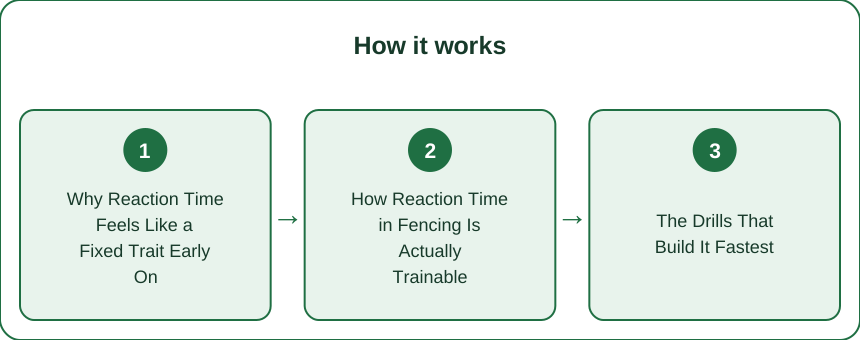
The Drills That Build It Fastest
What actually works: the closed-drills-with-a-known-limited-set-of-responses-before-open-free-bouting (the practicing against a known, limited set of attack patterns repeatedly before moving to unpredictable free bouting, building recognition speed for common patterns before adding full unpredictability, per the fencing-footwork-conditioning-guide logic — the closed-drills-with-known-limited-patterns-build-the-recognition-speed-foundation-before-open-bouting-adds-full-unpredictability), the the-simple-reactive-footwork-drills-separate-from-blade-work-train-the-raw-physical-reaction-component-specifically (the basic reactive footwork drills — reacting to a visual or verbal cue with immediate movement, without the added complexity of blade work — isolating and training the raw physical reaction component specifically — the isolating-footwork-reaction-drills-from-full-blade-work-trains-the-raw-physical-component-more-directly), the the-video-review-of-your-own-bouts-builds-pattern-recognition-outside-of-live-training-time-too (the reviewing recorded bouts specifically to identify and consciously recognize attack patterns after the fact building the same pattern library through a lower-pressure, repeatable review process outside live training time — the video-review-builds-pattern-recognition-through-a-repeatable-lower-pressure-process-outside-live-training-time-too), and the frame (the fastest-building drills as closed pattern-limited drills before open bouting, isolated reactive footwork drills for the raw physical component, and video review for building pattern recognition outside live training time — a genuinely trainable skill once approached with the right structured practice rather than assumed to simply be innate).
New fencers assume reaction speed is a fixed trait because experienced fencers’ apparently instant reactions actually reflect rapid pattern recognition of familiar attack setups rather than pure raw reflex speed, a distinction invisible from outside, while a beginner without that accumulated pattern library genuinely has to process every action from scratch. Reaction time is actually trainable through repeated exposure to common attack patterns that builds recognition speed, narrowed-decision drills that limit the response options during practice before transferring to the full unpredictability of a real bout, and separately training raw physical reaction speed and cognitive decision speed as genuinely distinct components. The fastest-building drills are closed pattern-limited practice before moving to open free bouting, isolated reactive footwork drills that train the physical reaction component without the added complexity of blade work, and reviewing recorded bouts specifically to consciously identify attack patterns through a repeatable, lower-pressure process outside live training time.
Keep Reading
This article is for general informational and styling purposes only. Fit, sizing, and product availability may vary.