How to Come Back to Fencing After a Summer Off
Quick Answer: Distance judgment and reaction timing decay much faster than strength or footwork mechanics, so your first sessions back should prioritize partnered distance drills over conditioning or bouting. Expect footwork to feel normal within one session, blade actions within two, and distance to take three or four. Bouting on night one mostly teaches you that you are rusty, which you already knew, and risks the knee and Achilles that six weeks of no lunging left unprepared.
The frustrating part of a fencing comeback is that the parts that feel fine and the parts that actually returned are not the same set.

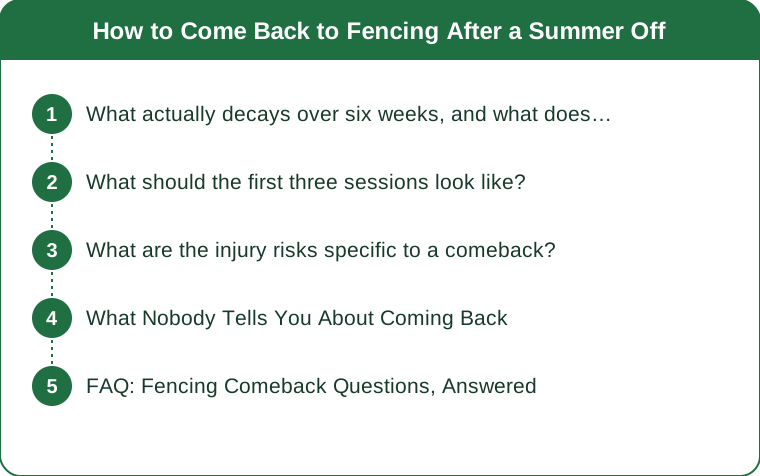
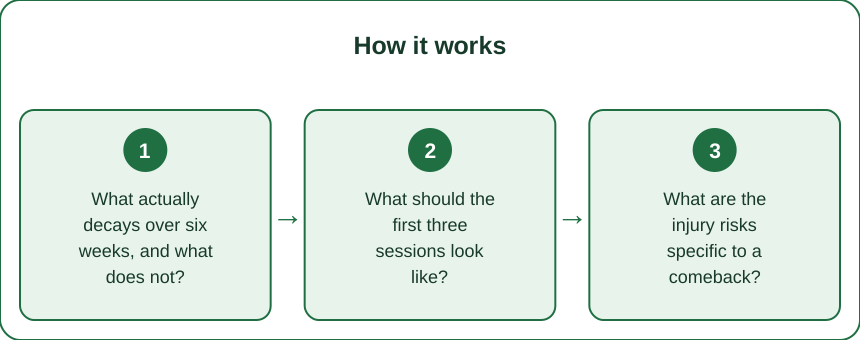
What actually decays over six weeks, and what does not?
Footwork mechanics hold up well. The advance, retreat and lunge are deeply learned motor patterns. They feel slightly less crisp and they are essentially intact.
Aerobic and leg conditioning decays modestly, and if you did anything active over the summer, barely at all.
Blade actions and point control decay a little more, showing up as imprecise parries and a point that arrives near rather than on target.
Distance judgment decays the most, by a wide margin. It is a continuously calibrated perceptual skill built from thousands of repetitions against moving opponents, and it degrades without that input. You will find yourself consistently short on the lunge or too close on the preparation.
Reaction timing against a real opponent is second. Reacting to a blade is not a general reflex - it is trained pattern recognition specific to fencing, and it does not transfer from anything you did in July.
Which means: the conditioning you are worried about is fine and the perception you are not thinking about is the actual gap.
What should the first three sessions look like?
Session 1: footwork and distance, no bouting. Full warm-up, footwork up and down the strip, then partnered distance work - one person advances and retreats, the other maintains a fixed distance without blade contact. Twenty minutes of this does more than an hour of bouting.
Session 2: add blade work and simple pre-arranged actions. Straight attacks, simple parry-riposte, at controlled speed. The goal is precision, not intensity. Then a small number of light bouts at the end if you feel good.
Session 3: normal practice with bouting, accepting that your results will be worse than your fitness suggests.
Take a lesson early if you can. A coach will identify what actually degraded in ten minutes and give you two weeks of targeted work instead of three weeks of guessing.
Space the first two sessions 48 hours apart. The lunge loads the quadriceps eccentrically in a way almost nothing else does, and the delayed soreness after a first session back is often significant.

What are the injury risks specific to a comeback?
The comeback period has a distinct risk profile, and it is worth being deliberate.
The lead knee on the lunge. Six weeks without lunging means the quadriceps and the tendon are not conditioned for the deceleration load, which is the largest single demand in the sport. Building lunge volume gradually across two weeks matters more than any other precaution.
The Achilles and calf on the rear leg. Explosive push-off from a static position after a layoff is a classic mechanism, and it tends to happen in the first fast bout rather than during drills.
The forearm and wrist on the weapon arm. Grip-related overuse shows up quickly when you jump straight back to full practice volume.
The lower back. The fencing stance places asymmetric demand on the trunk and it takes a couple of sessions to re-adapt.
Warm up longer than you think you need to - 12 to 15 minutes including dynamic hip and ankle work before any lunging. This is the least interesting advice in the sport and the most consistently vindicated.
This is general information, not medical advice.
What Nobody Tells You About Coming Back
Your results will be worse than your fencing. In the first weeks back you will lose bouts to people you used to beat, largely on distance errors rather than on any deficit in technique. It corrects quickly and it feels much worse than it is.
The layoff sometimes fixes a bad habit. A pattern you had grooved in - over-reliance on one action, a telegraphed preparation - can loosen during a break, which makes the comeback an unusually good window to change something deliberately.
Your equipment degraded while you did not. Check blades for bends and cracks, test the body cord, and inspect mask mesh for any deformation or rust before the first session. Gear that sat in a bag all summer is a genuine safety item, not an administrative one.
Everyone else is also rusty. The club-wide September standard is lower than the June standard, and the person beating you is probably having the same private conversation with themselves.
Three weeks is the usual number. Most returning fencers report feeling like themselves again in about three weeks of twice-weekly practice, which is worth knowing on the night you consider quitting.
FAQ: Fencing Comeback Questions, Answered
How long until my distance comes back?
Typically three to four sessions of actual partnered work. It returns faster with distance-specific drills than with bouting, because bouting gives you fewer clean repetitions of the exact skill.
Should I do conditioning before going back to the club?
A week of lunges, split squats and calf work before your first session meaningfully reduces the first-week soreness and the injury risk. It is not required, and it makes the return more pleasant.
Is it worth taking a lesson in the first week back?
Yes, and it is probably the highest-value week for a lesson in the whole year. A coach sees what degraded far faster than you will feel it, and correcting it early prevents you grooving a compensation.
I feel slower than before. Is that fitness or timing?
Almost always timing rather than speed. Actual movement speed decays slowly; the recognition of when to move decays quickly, and being late feels identical to being slow from the inside.
TL;DR:
- Footwork and conditioning survive a summer off; distance judgment and reaction timing do not.
- Spend session one on partnered distance drills, session two on blade work, and bout properly in session three.
- The lunge is the injury risk - build volume across two weeks and warm up 12 to 15 minutes before lunging.
- Check your blades, body cord and mask before the first night back.
- Most fencers feel like themselves again after about three weeks of twice-weekly practice.
The comeback is short and it does not feel short. Spend the first two sessions on the thing that actually left, and you skip most of the frustrating month that people who go straight to bouting sign up for.
Keep Reading
This article is for general informational and styling purposes only. Fit, sizing, and product availability may vary.