Coming Back to the Piste After a Summer Off: The First Three Sessions
Quick Answer: After a summer break, the skills that decay fastest are distance judgement and blade sensitivity - not fitness. Both come back within three to five sessions if you train them directly, and neither improves from bouting hard on day one. Spend the first session on footwork and point control alone, the second on paired distance work, and only bout properly in the third. The soreness people associate with returning is almost entirely from lunging, which is a heavily eccentric movement your legs have not done in months.
The fastest way to have a bad first month is to bout competitively in week one.
This is general information rather than medical advice.

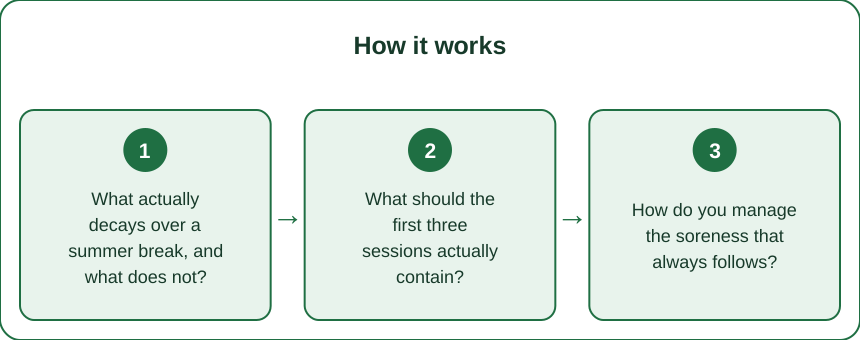
What actually decays over a summer break, and what does not?
Perceptual skills go first, motor patterns hold, and fitness sits in between.
Fastest to decay - distance judgement. The ability to know, without measuring, whether you can hit from where you are standing. This is a continuously calibrated perceptual skill and it degrades noticeably within two to three weeks of not fencing. It is also the thing that makes returning fencers feel worst, because every action lands short or long.
Second - blade sensitivity. Feeling pressure and intention through the blade. Fine tactile discrimination declines without practice, and it returns faster than distance does.
Third - timing and tempo. Reading when an opponent is committed. This depends on both of the above, so it recovers last even though the underlying ability is intact.
What holds up well:
- Footwork mechanics. The pattern is well learned and does not disappear. It becomes slower and less crisp, not wrong
- Tactical knowledge, which is largely declarative and does not decay meaningfully over one summer
- Point control, which drops somewhat but recovers within one or two sessions of target work
Fitness, which is the part people worry about and which matters least. General conditioning declines, but fencing-specific fitness is mostly about repeated explosive lunges and rapid direction changes, which returns within a few weeks.
Why this ordering matters. If distance is what decayed most, that is what the first sessions should train, and it is trained by controlled paired work rather than by bouting. Bouting with poor distance mostly practises poor distance.
What should the first three sessions actually contain?
One session per problem, in the order the problems recover.
Session one: footwork and point control, no opponent.
- 20 minutes of footwork. Advance, retreat, change of direction. Slow and precise before fast - the goal is restoring crispness, not conditioning
- Lunges: start at 20 to 30 total, no more. This is the single most important number in the whole return. The lunge is heavily eccentric on the front quad and rear hamstring, and 100 lunges on day one produces four days of soreness
- 15 minutes of target work. Point control on a wall target, at a fixed distance, then varying distance
- Finish with mobility, particularly hip and ankle
Session two: paired distance work, no scoring.
- Distance following. One partner advances and retreats freely, the other maintains exact distance. 10 minutes, swapping roles. This is the highest-value drill for a returning fencer and it is almost always skipped
- Simple attacks on a cooperative partner at correct distance, then at a distance the partner varies
- Parry and riposte drills, slow, focusing on blade feel rather than speed
- Still no bouting
Session three: introduce bouting, with constraints.
- Constrained bouts first - one action only, or attacks only, or a limited target. Constraints prevent falling back on the one thing you can still do
- Short bouts to 5, with rest, rather than long ones
- Full bouting at the end of the session, not the start
Across all three:
- Warm up properly. 10 minutes minimum, including hip and ankle mobility, before anything explosive
- Stop while it is still going well. The temptation to continue when it starts to click is exactly what produces the week-two setback

How do you manage the soreness that always follows?
It comes from lunging, it peaks at 48 hours, and volume is what controls it.
Why lunging specifically. The lunge involves a rapid eccentric load on the front quadriceps as you land and a stretch on the rear hip flexor and adductor. Eccentric loading produces substantially more delayed onset muscle soreness than concentric work, and the lunge is close to a pure eccentric challenge for the front leg.
Where the soreness lands:
- Front leg quadriceps, the most common
- Rear leg adductor and hip flexor, which is the one that limits people most
- Forearm and grip, from blade work
- Lower back, if the on-guard position has degraded
Controlling it:
- Cap lunges at 20 to 30 in session one, 40 to 50 in session two, and normal volume by session four. Volume, not intensity, drives soreness
- 48 hours between the first sessions, not 24
- A proper warm-up including dynamic hip work, which reduces both soreness and strain risk
- Adductor and hip flexor mobility work in the days between sessions
The repeated bout effect works in your favour. After one exposure, the same session produces dramatically less soreness, and the protection lasts weeks. Session two is far easier than session one even if it is harder.
Injury risks specific to a return, which are worth naming:
- Adductor strain on the rear leg, the classic returning-fencer injury. Caused by explosive lunging on cold, unconditioned tissue
- Achilles and calf, from repeated rapid direction change
- Knee, particularly the front knee, if lunge depth exceeds current control
Sharp pain rather than diffuse ache, particularly in the groin or the back of the leg, is a stop signal rather than something to work through.
What Nobody Tells You About Coming Back
Your worst sessions are session two and three, not session one. Session one runs on enthusiasm and low expectations. By session three you expect to be back and you are not, and that gap is where people get discouraged. It is the most predictable dip in the whole return.
Distance comes back suddenly, not gradually. Most returning fencers describe it as a switch rather than a slope - three or four sessions of everything landing wrong, then a session where it simply works. Knowing it arrives in a step rather than a ramp makes the frustrating sessions much easier to sit through.
You will fence better against people you know. Familiar opponents let you rely on tactical knowledge, which did not decay. Fencing only familiar opponents in the first fortnight hides the distance problem rather than fixing it, so mix in unfamiliar ones once the drills are done.
Your kit needs checking before you need it. Summer storage means oxidised body wire contacts, a stiff weapon, and a mask that has been compressed in a bag. Test everything at home rather than discovering it on the piste, and check the mask bib and blade for damage before the first session.
Left-handed fencers face a longer readjustment on both sides. Right-handers who have not fenced a lefty all summer will struggle for a few sessions, and lefties returning face opponents who have lost their calibration. This is worth naming out loud rather than being surprised by.
The people who return best treat the first fortnight as training, not as fencing. The ones who struggle treat it as a test of whether they still have it. The measurable difference by week four is substantial, and it comes entirely from what happened in week one.
FAQ: Returning to Fencing, Answered
What comes back slowest after a break?
Distance judgement, followed by blade sensitivity. Both are perceptual skills that need continuous calibration, and both respond to paired drills rather than to bouting.
How many lunges should I do in the first session?
Twenty to thirty total. The lunge is heavily eccentric on the front leg, and volume is what drives the two-day soreness people associate with returning.
When should I start bouting again?
Session three, with constraints - one action, or attacks only, or a limited target. Bouting with poor distance mostly practises poor distance.
Why does everything land short or long?
Distance judgement decays within two to three weeks of not fencing. Distance-following drills with a partner restore it faster than anything else, typically within three to five sessions.
How long until I am back to where I was?
Most fencers report feeling roughly normal within four to six sessions after a summer break, with distance returning as a sudden step rather than a gradual improvement.
What injury should I watch for?
Rear-leg adductor strain, which is the classic returning-fencer injury and comes from explosive lunging on unconditioned tissue. Sharp groin pain is a stop signal, not something to push through.
TL;DR:
- Distance judgement decays fastest and fitness matters least - train distance first
- Session one is footwork and target work, session two is paired distance drills, session three introduces constrained bouting
- Cap lunges at 20 to 30 in the first session; lunge volume is what causes the two-day soreness
- Leave 48 hours between the first sessions, and stop while it is still going well
- Distance returns as a sudden step around session four, not as a gradual improvement
The first fortnight back is training, not a test of whether you still have it. Treating it as the latter is what makes it take a month.
Keep Reading
This article is for general informational and styling purposes only. Fit, sizing, and product availability may vary.