Why Elite Fencers Train Their Eyes Separately From Their Footwork
Quick Answer: Fencing vision training targets peripheral awareness and tracking speed through drills like ball tracking, strobe glasses, and reduced-cue sparring, separate from footwork or blade drills. Coaches who add 10-15 minutes of dedicated vision work per session report faster read-and-react times within 6-8 weeks, since much of a fencer’s reaction time is actually visual processing speed, not muscle speed.
Watch a high-level bout and the actual blade movement takes a fraction of a second — what separates a fast reactor from a slow one usually isn’t leg speed, it’s how quickly the eyes pick up the cue in the first place.

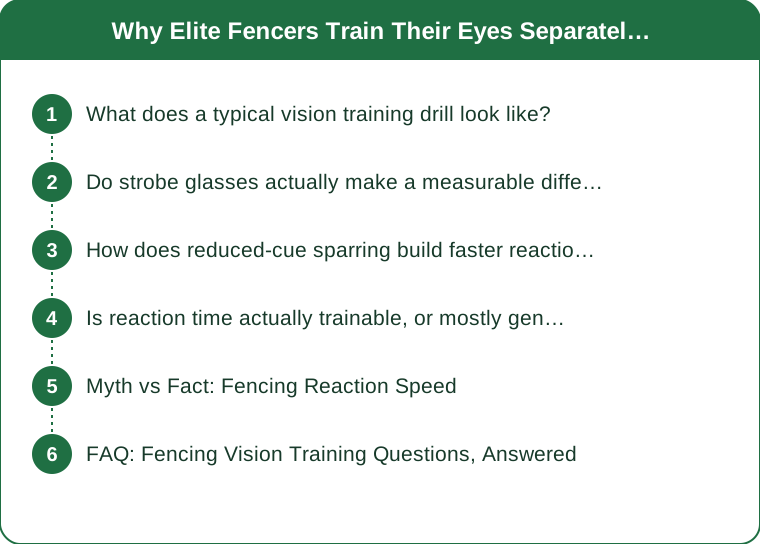
What does a typical vision training drill look like?
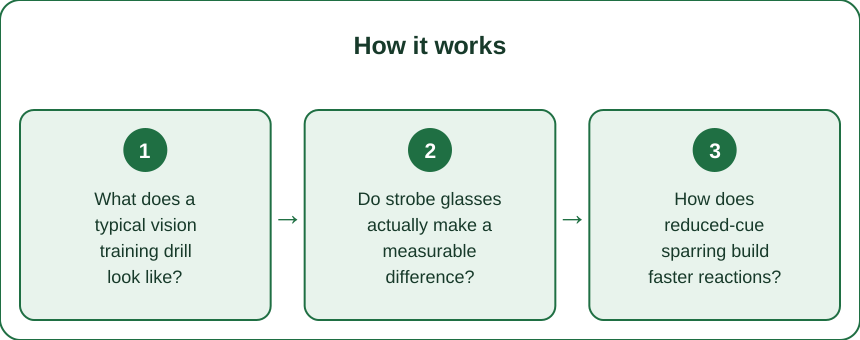
Tracking a thrown or bounced ball while maintaining peripheral awareness of a second moving object is a common baseline drill, training the eyes to process more than one visual input at once — closer to what happens during an actual bout than any static drill can replicate.
Do strobe glasses actually make a measurable difference?
Many fencing programs report faster reaction times after regular strobe-glasses training, which works by intermittently blacking out vision to force the brain to fill gaps and react faster to the visual information it does get — though it’s a supplement to, not a replacement for, standard footwork and blade drills.
How does reduced-cue sparring build faster reactions?
Sparring with a partner who deliberately minimizes normal tells (reduces the usual shoulder or hip cues that signal an attack) forces the fencer to react to smaller, later visual information — a fencer trained this way often reacts faster against opponents who do telegraph normally.

Is reaction time actually trainable, or mostly genetic?
It’s a mix, but the trainable portion is larger than most beginners assume — visual processing speed responds to consistent drilling the same way footwork does, which is why programs that add dedicated vision work see measurable gains over a training block rather than plateauing.
Myth vs Fact: Fencing Reaction Speed
Myth: Faster legs are the main driver of reaction speed in fencing. Fact: Visual processing speed — how fast the brain identifies and interprets the cue — is a major separate factor, and slow legs with fast visual processing often out-react fast legs with slow processing.
Myth: Reaction time can’t really be trained past a certain point. Fact: Structured vision drills over 6-8 week blocks show measurable improvement in most fencers, similar to how footwork drilling improves footwork.
Myth: Strobe glasses are just a gimmick. Fact: Multiple fencing and other combat-sport programs use them specifically because forcing the brain to fill visual gaps measurably speeds up processing over time.
FAQ: Fencing Vision Training Questions, Answered
How often should vision drills be done per week?
Most programs add them 2-3 times a week for 10-15 minutes, layered onto regular footwork and blade training rather than replacing any of it.
Can vision training be done without special equipment like strobe glasses?
Yes — ball tracking, reduced-cue partner sparring, and peripheral awareness drills all work with no special gear at all.
Does this type of training help beginners or only advanced fencers?
Both, though beginners often see faster initial gains since basic visual tracking for the sport hasn’t been trained at all yet.
TL;DR:
- A meaningful share of fencing reaction time is visual processing speed, not leg speed
- Ball tracking, strobe glasses, and reduced-cue sparring are the three most common dedicated vision drills
- 10-15 minutes, 2-3 times a week, layered onto normal training shows gains within 6-8 weeks
- The trainable portion of reaction time is larger than most beginners assume
The fastest reactors on the strip usually aren’t the fastest runners — they’re the ones whose eyes picked up the cue half a beat sooner.
Keep Reading
This article is for general informational and styling purposes only. Fit, sizing, and product availability may vary.