Why Your Distance Judgement Falls Apart Against an Unfamiliar Opponent
Quick Answer: Distance in fencing is not a fixed measurement - it is a relationship between two people’s reach, speed, and preparation habits. Against familiar opponents you are not measuring distance so much as recalling it. A new opponent invalidates that stored model, and until you rebuild it you are effectively fencing blind for the first few touches. The fix is a deliberate calibration process in the opening exchanges rather than an attempt to fence normally.
Good fencers do not have better distance. They rebuild the model faster.

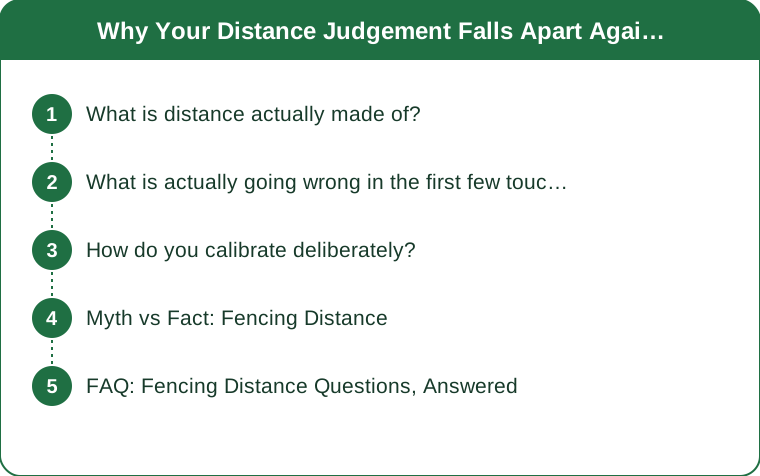
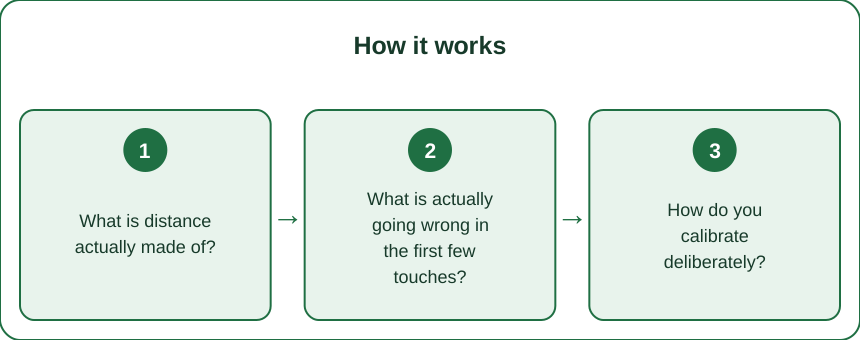
What is distance actually made of?
Four variables, only one of which you can see from en garde.
Their reach. Arm length plus blade length plus torso lean. Visible, roughly, before the bout starts.
Their acceleration. How quickly they cover ground once they commit. Not visible at all until they do it. Two fencers with identical reach can have effective attacking distances that differ by a foot or more because one accelerates harder.
Their preparation habits. Whether they close distance in small steps or one large one, whether they step before or after the blade action, whether they retreat under pressure or stand. This determines where they will be a half-second from now, which is the distance that actually matters.
Their willingness to commit from distance. Some fencers only attack from close. Others attack from further than looks sensible and make it work through speed. Until you have seen one attack, you cannot know which.
When you fence a clubmate you have all four stored in memory, and your body uses them without conscious effort. That is what good distance feels like from the inside - not measurement, but prediction from a model you did not know you had.
A new opponent gives you variable one and nothing else. Which is why the sensation is so disorienting: your reflexes are executing confidently against a model that does not apply.
What is actually going wrong in the first few touches?
You are running an old prediction against new data, and the errors are systematic rather than random.
Attacks falling short means their effective retreat speed is higher than your model expected, or their preparation was drawing you in rather than committing. Your body launched at the distance that works against your usual training partner.
Attacks arriving late means they are faster off the mark than expected, so your parry timing, calibrated to a slower opponent, is behind.
Being hit on preparation repeatedly means they read your step pattern faster than you read theirs. Newer opponents are not necessarily better at this - but you are an unknown to them too, and the fencer who calibrates faster wins the first exchanges.
The important part is that these errors are consistent in direction. If your first three attacks all fell four inches short, that is not bad luck; it is a systematic offset in your model, and a systematic offset is correctable in one adjustment.
Most fencers do not treat it that way. They register three failed attacks as three separate failures, get tense, and start rushing - which degrades distance further, because tension shortens the lunge and speeds up the step in ways you cannot feel from inside.
So the first practical skill is diagnostic: after two failed actions, ask whether they failed in the same way. If yes, you have a measurement, not a mystery.
How do you calibrate deliberately?
By spending the first exchanges gathering information rather than trying to score, which requires accepting a touch or two as the cost.
Use false attacks with no commitment. A short, deliberately out-of-distance advance-lunge that you never intend to land tells you how they react - do they retreat, parry, counter-attack, stand still? That is worth more than a scoring attempt.
Vary your own distance deliberately. Step in slightly further than feels safe, once, and see whether they take it. A fencer who attacks the moment you enter their range has just shown you their range.
Watch their feet during your preparation, not their blade. Blade actions are deceptive by design. Foot movement is mechanically constrained and much harder to fake. Where their rear foot goes tells you whether they are loading for an attack or preparing to retreat.
Count their step rhythm. Most fencers have a preferred cadence under pressure. Once you have it, you can time an attack into the gap between their steps, which is when they cannot accelerate backward.
Give away one touch cheaply and read it. This sounds like poor advice and it is standard practice at higher levels. A touch that tells you their attacking distance and speed is a good investment in a 15-point bout. It is a bad investment in a 5-point pool bout, which is exactly why pool bouts against unknown fencers are so much harder than they look.
One concrete drill for this: at club, spend a session bouting only people you rarely fence, with a rule that the first three touches of each bout are for information only. It is uncomfortable and it improves calibration speed faster than anything else.
Myth vs Fact: Fencing Distance
Myth: Distance is a fixed measurement you develop over time. Fact: It is a relationship, recalculated for every opponent. What you develop over time is the speed at which you recalculate. An experienced fencer facing a completely new opponent still spends the opening exchanges calibrating - they just do it in two touches rather than six.
Myth: Taller opponents are always at an advantage on distance. Fact: Reach advantage is real, but it comes with a slower change of direction and a longer distance to retreat through. Short fencers who succeed against tall ones generally do it by living at one of two distances - well out, or very close - and refusing to fence in the middle range where reach dominates.
Myth: If your attacks keep falling short, you should lunge harder. Fact: Lunging harder usually makes it worse. A harder lunge is more committed and more readable, and if the problem is that they are retreating, a bigger attack into a retreat is just a bigger miss. The answer is almost always to close distance in preparation first, then attack short.
Myth: Video review will not help with something this instinctive. Fact: Video is unusually good for this specific problem, because systematic offsets are obvious on film and invisible in the moment. Watching three failed attacks in a row and seeing that all three finished at the same distance is the fastest available diagnosis.
FAQ: Fencing Distance Questions, Answered
How long should calibration take in a bout?
Aim for two to three exchanges. Beyond about four, you are not calibrating, you are hoping. If you have not read them by then, change something structural - your distance preference, your tempo, or your line - rather than continuing to gather data on a plan that is not working.
Does this apply differently across the three weapons?
The principle is universal but the emphasis shifts. In epee, where the whole body is target and there is no priority, distance errors are punished most immediately. In foil and sabre, right-of-way means a distance error can sometimes be rescued by winning the priority argument, which makes calibration slightly more forgiving but no less important.
Why is it worse in competition than at club?
Three reasons stacked: every opponent is unfamiliar, pool bouts to five give you almost no calibration budget, and adrenaline shortens your perception of time and lengthens your steps without you noticing. The last one is real and largely uncontrollable - which is a good argument for deliberately fencing shorter and closer than feels right in the first competition bout of the day.
Can I practise this alone?
Partly. Footwork with distance targets - advancing to a mark, lunging to a specific point - builds the motor consistency that makes calibration possible. But the calibration skill itself requires unfamiliar opponents, which means open bouting and visiting other clubs is the actual training method.
TL;DR:
- Distance is a relationship between two fencers, not a fixed measurement, and a new opponent invalidates your stored model.
- Errors are systematic, not random - three attacks falling short the same way is a measurement you can correct in one adjustment.
- Calibrate deliberately with false attacks, deliberate distance probes, and watching their feet rather than their blade.
- Lunging harder into a retreating opponent makes it worse; close in preparation and attack short instead.
- Competition is harder because every opponent is new, pool bouts give you no calibration budget, and adrenaline lengthens your steps.
Bout unfamiliar people at club and treat the first three touches as information. Calibration speed is the trainable skill.
Keep Reading
This article is for general informational and styling purposes only. Fit, sizing, and product availability may vary.