Why Fencing Footwork That Looks Clean in Drills Falls Apart in an Actual Bout
Quick Answer: Drilled footwork is performed on a predictable rhythm with no real consequence for timing errors, while bout footwork has to adapt in real time to an opponent’s unpredictable distance and tempo — that added decision-making layer is what breaks down technique that looked solid in isolation.
It’s one of the most common and most misunderstood frustrations in early fencing training: the footwork itself hasn’t actually regressed, but the conditions it now has to work under are completely different.
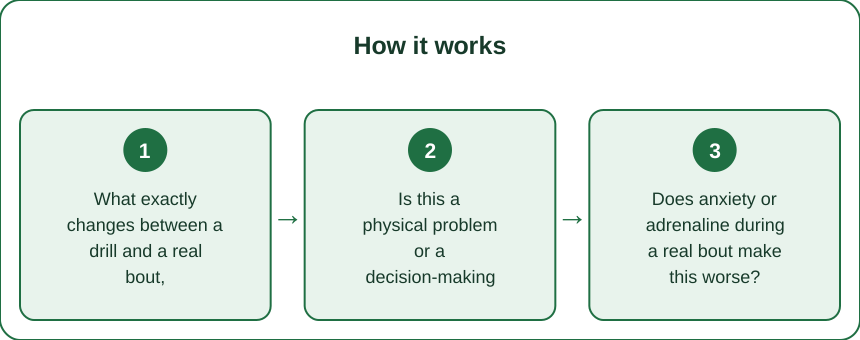
What exactly changes between a drill and a real bout, mechanically speaking?
In a drill, distance and timing are fixed or slow-predictable, so the footwork pattern can be executed from memory. In a bout, the opponent’s distance changes constantly and unpredictably, meaning the same footwork now has to be selected and adjusted in real time based on incoming information — that’s a fundamentally different cognitive task layered on top of the same physical movement.
Is this a physical problem or a decision-making problem?
Mostly decision-making — the legs generally know how to perform an advance or a lunge, but choosing the right footwork at the right distance, under time pressure, while also reading the opponent is where the breakdown actually happens, which is why purely drilling footwork more in isolation often doesn’t fix the bout-specific problem on its own.
Does anxiety or adrenaline during a real bout make this worse?
Yes, measurably — elevated arousal under bout pressure tends to narrow attention and revert movement toward simpler, more habitual patterns, which is part of why fencers under pressure sometimes fall back to a smaller, less varied set of footwork options than they actually have available and have drilled.
What kind of training actually closes this specific gap?
Footwork drills done against a live, reactive partner rather than a fixed count are the standard bridge — starting with a partner who moves unpredictably but without blades, then adding light bladework, gradually reintroduces the real-time decision element that pure solo drilling doesn’t train.
5 Mistakes Fencers Make Trying to Fix Bout Footwork
- Drilling more repetitions of the same fixed-count pattern, which reinforces the drill skill but not the adaptive skill actually missing.
- Assuming the issue is fitness-related and adding conditioning alone, when the gap is mostly cognitive.
- Avoiding live footwork practice because it “doesn’t feel as clean,” when the messiness is the actual training stimulus needed.
- Not slowing bouts down deliberately with a coach or partner to isolate footwork decisions from full-speed bladework.
- Expecting the gap to close in a single session rather than over weeks of live-footwork exposure.
FAQ: Fencing Footwork Under Pressure, Answered
How long does it typically take for drilled footwork to transfer reliably into bouts?
There’s wide individual variation, but many fencers report a noticeable shift after several weeks of consistent live-footwork practice specifically, rather than more solo drilling alone.
Does video review of actual bouts help identify the specific breakdown pattern?
Yes — reviewing footage often reveals a fencer reverting to one or two default footwork patterns under pressure, which is useful, specific information that’s hard to notice in the moment during a live bout.
Is it normal for footwork to regress temporarily when moving up to more experienced opponents?
Yes, very normal — a more experienced opponent creates faster, less predictable distance changes, which can temporarily expose the same drill-to-bout gap again at a new skill level.
TL;DR:
- Drills are performed on fixed timing; bouts require real-time adaptive decisions
- The breakdown under pressure is mostly cognitive, not a physical footwork failure
- Elevated bout adrenaline narrows footwork choices back toward simple habitual patterns
- Live, reactive partner drills — not more fixed-count solo drilling — close the specific gap
The footwork was never broken — it just hadn’t been trained for the unpredictability a real opponent adds.
Keep Reading
This article is for general informational and styling purposes only. Fit, sizing, and product availability may vary.