Why Your Fencing Grip Tightens as the Bout Goes On
Quick Answer: Your grip tightens because tension is a stress response, not a technique choice. As the score gets close, sympathetic arousal increases baseline muscle tone across the whole arm, and the hand is where it shows first. A tight grip then reduces point control, because fine blade movement comes from small finger adjustments that a clenched hand cannot make. The fix is a deliberate release cue between touches, not trying to relax mid-action.
Touch one, your point control is precise. Touch ten, the same parry-riposte lands wide and your forearm is burning, and you have not changed anything you know about.

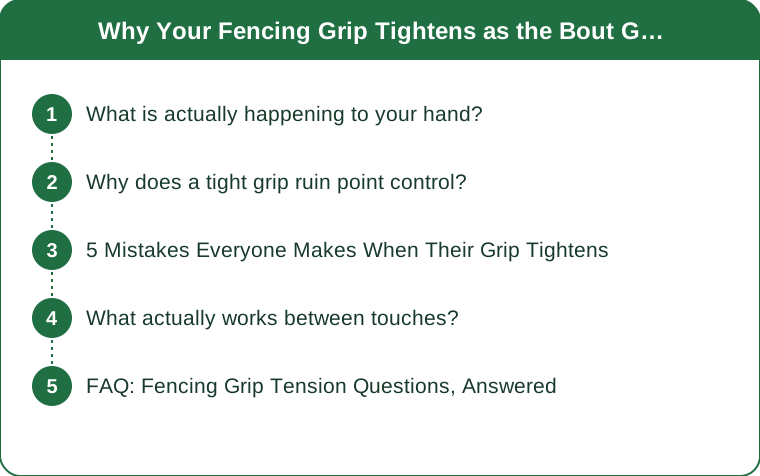
What is actually happening to your hand?
A specific and predictable physiological sequence, running on a timescale of minutes.
Arousal raises baseline muscle tone. Under competitive stress, the nervous system increases resting tension in the muscles - a useful preparation for fast action, and one that does not distinguish between the muscles you need tense and the ones you do not.
Grip strength is the most sensitive indicator. The hand has an enormous share of motor cortex representation, and grip is the classic output that changes under stress. You will grip a pen harder in a difficult conversation for exactly the same reason.
The forearm flexors fatigue quickly under sustained tension. Continuous low-level contraction is more fatiguing than intermittent hard contraction, because blood flow to the muscle is restricted while it is held tight.
And fatigue increases tension further. A tiring muscle recruits more motor units to produce the same force, which feels like - and is - more effort and more tension. This is the loop: stress raises tension, tension causes fatigue, fatigue raises tension.
Why does a tight grip ruin point control?
Because the blade is steered by fingers, and a clenched fist has no fingers available.
Fine blade manipulation comes from the thumb and index finger. The manipulators make the small, fast adjustments that find the target and control the line. The remaining fingers hold the weapon in place.
Gripping recruits everything at once. When the whole hand clenches, the manipulators are already contracted, so the small differential movements they should be making are no longer available. The blade then has to be moved by the arm, which is slower, larger, and much easier for an opponent to read.
Point control degrades before anyone notices the grip. The visible symptom is a wide riposte or a point that lands flat. The cause is two joints away.
Distance judgement suffers too. Arm tension shortens your reach slightly and slows extension, so touches that should land at the edge of distance fall short - and you compensate by stepping in, which is exactly what a patient opponent wants.
And parries get heavy. A tense parry is a block rather than a deflection, which uses more energy and leaves you slower to riposte.

5 Mistakes Everyone Makes When Their Grip Tightens
Mistake 1: Trying to relax during the action. You cannot consciously release tension while executing a fast motor pattern - attention is already spent. Release happens between touches, in the reset, not in the phrase.
Mistake 2: Loosening the glove. People assume the equipment is the problem and end up with a weapon that moves in the hand, which triggers more gripping, not less. A slightly loose glove is worse than a snug one.
Mistake 3: Shaking the arm out. It feels productive and does almost nothing for forearm flexor tension. Opening the hand fully and extending the fingers for three seconds does considerably more, because it actively lengthens the muscles that are held short.
Mistake 4: Training grip strength to fix it. A stronger grip does not reduce the tendency to over-grip - and the third mistake here is the one that surprises people, because stronger hands often grip harder under stress, not softer.
Mistake 5: Assuming it is conditioning. Forearm burn in the last third of a bout reads as a fitness problem, so people do more forearm work. If your grip were relaxed, your forearm would not be working hard enough to burn in the first place. It is a tension problem wearing a conditioning costume.
What actually works between touches?
A short, repeatable reset that you run every single time, whether or not you feel tense.
Open the hand completely. Take the hand fully off the grip for two to three seconds, extend the fingers, and let the weapon hang from the thumb and index. This is the single highest-value habit, and it takes less time than walking back to the en garde line.
Roll the shoulder once. Arm tension does not stop at the wrist. One deliberate shoulder roll interrupts the pattern up the whole chain.
Exhale longer than you inhale. A slow exhale is the fastest available lever on sympathetic arousal - roughly four counts in, six to eight out, twice, fits comfortably into the gap between touches.
Re-set the grip deliberately. Place the fingers rather than grabbing. The weapon should be held with about the pressure you would use to hold a small bird - firm enough not to drop it, loose enough not to harm it.
Build the cue in training, not in competition. Practice the release after every touch in club bouts so it is automatic when the score is 13-13. A habit you only use under pressure is not a habit.
And check it early, not late. Most fencers first notice tension at touch eight. Running the reset from touch one is what prevents the late-bout version entirely.
FAQ: Fencing Grip Tension Questions, Answered
Should my grip pressure change during a phrase?
Yes - it should be light in preparation and firmer at the moment of parry or the instant of the hit, then light again. Constant pressure is the problem; varying pressure is correct technique.
Does a different grip type help?
A pistol grip encourages finger control and can help, but it does not solve a stress response. People with pistol grips over-grip too. Fit matters more than type - a grip that is too large for your hand forces a clench.
Is forearm soreness after a session normal?
Mild soreness after a hard session, particularly early in a season, is normal. Burning pain during every bout in the second half is a tension signal worth addressing.
How long does it take to change the habit?
Most fencers notice a real difference within three to four weeks of running a deliberate between-touch reset. The physical change is quick; remembering to do it under pressure is what takes the time.
TL;DR:
- Grip tension is a stress response, not a technique flaw - arousal raises baseline muscle tone and the hand shows it first.
- A clenched hand cannot make the small finger adjustments that control the point, so precision degrades before you feel the tension.
- Release between touches, not during them: open the hand fully for three seconds, roll the shoulder, and exhale long.
- Forearm burn in the second half of a bout is usually tension, not conditioning - more grip training will not fix it.
The useful reframe is that this is not something going wrong with your fencing. It is your nervous system doing exactly what it does under pressure, in the one place that ruins point control. Fencers who fix it do not relax more - they build a two-second reset they run after every single touch, from the first one, and the late-bout version never arrives.
Keep Reading
This article is for general informational and styling purposes only. Fit, sizing, and product availability may vary.